
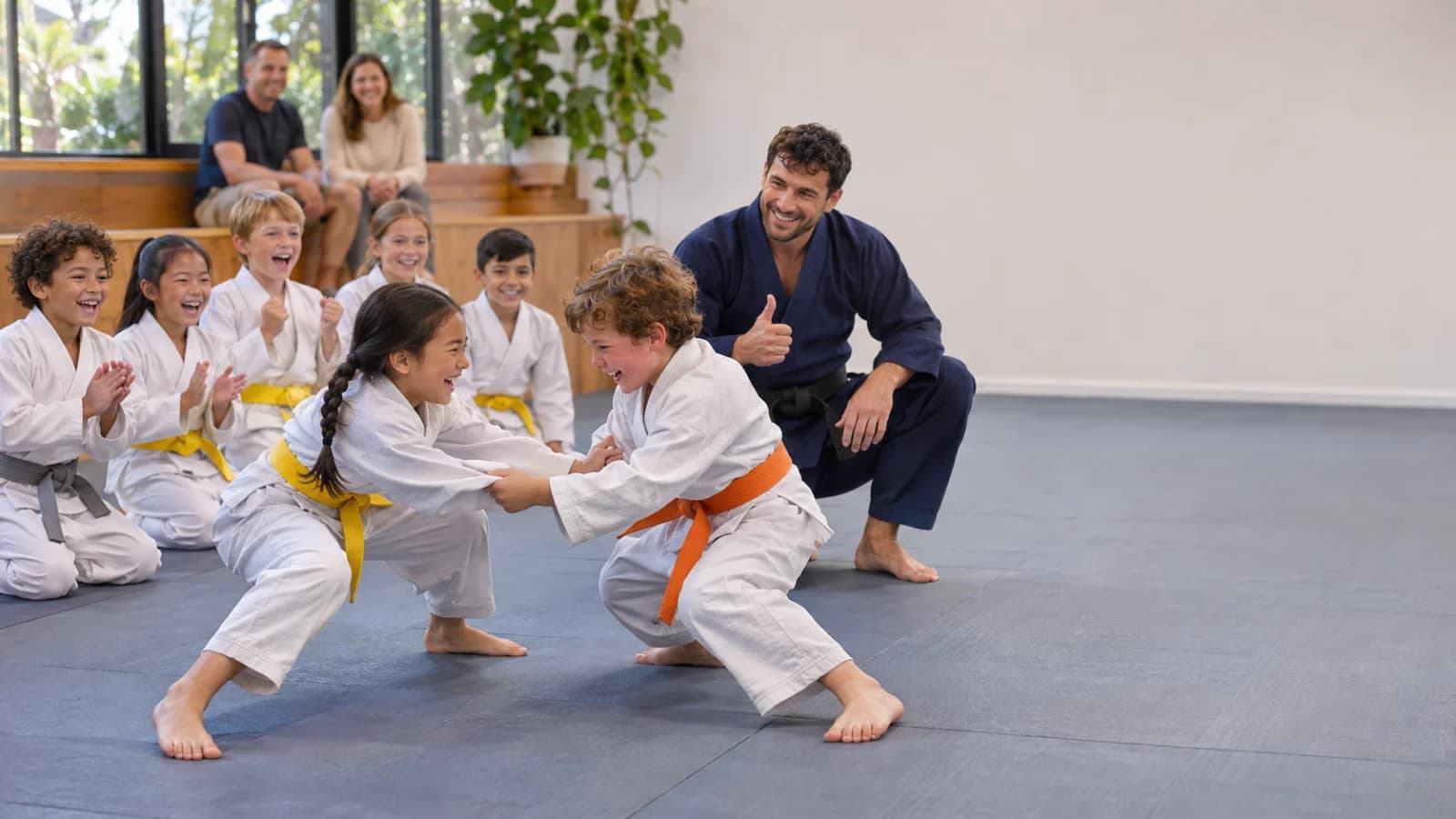
A successful kids BJJ program has five parts: age-based groups (roughly 4–6, 7–9, 10–12 and 13–15), short game-based classes, a visible progression system of stripes and kids belts, regular communication with parents, and attendance tracking that flags a child before they drop out. Get those five right and your kids program becomes the most stable part of your gym.
Key takeaways
Group kids by age first and by level second. A 5-year-old and an 11-year-old cannot share a class.
Keep classes short: about 30 minutes for ages 4–6 and 45–60 minutes for older kids.
Progress must be visible. Stripes, belts and a simple curriculum give kids a reason to come back and parents a reason to keep paying.
The parent is your real customer. Monthly updates and a quick call after 3 missed classes protect retention.
Participation drops in the early teens, so plan a teen pathway before your 12-year-olds leave.
Why does a kids BJJ program matter for your gym?
A kids BJJ program gives your gym a large, loyal and predictable member base. Families commit for years, siblings join, and parents often start training too.
The demand is there. According to AusPlay data reported by The Conversation (July 2023–June 2024), 71% of Australian children take part in sport or physical activity at least once a year, but only 40% are active at least once a week. The same data shows Australian families spend an average of $944 a year per child on sport.
Parents drive the decision. An AusPlay focus report on children's participation (Sport Australia, 2018) found that 75% of children with at least one active parent take part in organised activity, compared with 56% of children whose parents are inactive. For a BJJ gym, that is the case for parent classes and family memberships in one number.
Martial arts compete with karate, taekwondo, swimming and team sports for the same Saturday morning. In the 2018 AusPlay focus report, karate (2.8%) and general martial arts (1.7%) both sat in the top 20 organised activities for children. Your program needs a clear reason for a parent to choose jiu-jitsu.
What age groups should a kids BJJ program have?
Most successful kids BJJ programs split students into three or four age bands, then sort by level inside each band. Gracie Barra describes the same rule: "we first separate students by age, then by level".
Group | Ages | Class length | Sessions/week | Focus |
|---|---|---|---|---|
Little grapplers | 4–6 | 30 min | 1–2 | Movement, listening, games, falling safely. No submissions. |
Juniors | 7–9 | 45 min | 2 | Positions, escapes, simple techniques, game-based sparring |
Kids | 10–12 | 45–60 min | 2–3 | Technique chains, positional sparring, intro to competition |
Teens | 13–15 | 60 min | 2–3 | Near-adult structure, full rolling, a path to the adult class at 16 |
These ranges match what established programs publish. Gymdesk's guide recommends 30-minute classes for ages 4–9 and 45–60 minutes for ages 10–12. Gracie Barra runs 30-minute classes for its youngest group and 50–60 minutes for older kids, and does not teach submissions to children under 7.
If your timetable can only fit two kids classes, split at around age 8. That single split solves most attention-span and size problems.
How should a kids BJJ class be structured?
A kids BJJ class works best as a fixed template that repeats every session, so kids know what comes next and coaches can run it without improvising.
A 45-minute template that works for ages 7–12:
Warm-up game (5–8 min): a movement game such as shark-and-minnows or a sumo-style pushing game.
Review (5 min): repeat last class's technique.
New technique (10 min): one technique, shown in three steps or fewer.
Positional game (12–15 min): kids drill the technique inside a game with a clear win condition.
Cool-down and character lesson (5 min): one value (respect, resilience, focus) linked to something that happened on the mat.
Keep talking time short. Gymdesk notes that most kids "lack the attention span required to sit through 10-15 minutes of instruction". Show, let them try, then correct.
Ratios matter as much as structure. Gracie Barra aims for no more than 5 students per instructor in its youngest classes. A senior student or assistant coach on the mat makes classes safer and gives you a pipeline of future instructors.
How does the kids BJJ belt system work?
Kids in BJJ progress through a separate set of belts before they can earn an adult blue belt at 16. Under the IBJJF graduation system, the kids belts are grey, yellow, orange and green, each with white- and black-striped variations, and each has a minimum age (grey from 4, yellow from 7, orange from 10, green from 13).
IBJJF also suggests three ways to award stripes to kids: a monthly, a triannual and a quarterly system. Choose one and publish it to parents. A predictable rhythm turns progress into something kids look forward to.
Three rules keep kids grading fair and motivating:
Base it on a written curriculum. List the techniques and behaviours for each stripe, so parents can see the criteria.
Track attendance and skills per child. A stripe should reflect both.
Make grading day an event. Invite parents, take photos, and share them. For many families it is the moment they decide to stay another year.
For more detail, see our guide to BJJ belt promotion criteria.
How do you keep kids (and parents) from quitting?
Kids leave a BJJ program when progress stops being visible or when parents stop seeing value. Both are easy to catch early if you track attendance.
Age also plays a part. The 2018 AusPlay focus report found children's organised participation peaks between ages 9 and 11 and then declines from 12 to 14. Almost half of girls aged 12 to 14 cited a dislike of physical activity as a reason for not taking part. Your 11-year-olds are your highest-risk group, not your safest.
What works:
The 3-class rule. If a child misses 3 classes in a row, a coach contacts the parent that week.
Monthly parent update. One short message per child: what they learned, what is next, when the next stripe is likely.
A teen class before you need it. Teens want to train like adults. Give them their own class and a path to the adult mat at 16.
Girls' visibility. Female coaches, mixed and girls-only drilling options, and girls on your marketing all help keep girls in the program.
Family offers. Sibling and parent memberships raise the cost of quitting for the whole household.
Retention in kids programs is mostly a system, not a personality. Read our full guide on improving member retention in your BJJ gym
How do you market a kids BJJ program locally?
Parents search for outcomes, not techniques. Market confidence, focus, anti-bullying skills and fitness, and show real kids from your gym (with parent consent).
Local channels that bring in kids enrolments:
Google Business Profile: list "kids jiu-jitsu classes" as a service, add photos of kids classes and ask parents for reviews.
School holiday programs: a one- or two-week program is a low-commitment first step that often converts into term enrolments.
Schools and community groups: free anti-bullying workshops build trust with parents before they ever search.
Parent-friendly trial classes: let parents watch the first class, then sit with them for five minutes afterwards to explain the program and next steps.
Government activity vouchers: check whether your state or council runs a kids sport voucher scheme and whether your gym can register as a provider.
For the full trial-to-member process, see how to convert BJJ trial classes into paying members.
What safety and compliance does a kids BJJ program need?
Every adult who coaches or assists in kids classes needs a valid child-related background check, and your gym needs clear child-safety policies.
Australia: each state runs its own Working with Children Check. In Queensland it is the Blue Card.
New Zealand: police vetting for staff working with children.
United Kingdom: a DBS check.
United States: background checks, and in many cases SafeSport-style training.
Add first-aid certification, a written policy for parents (drop-off, pick-up, behaviour), and a clear rule on submissions by age. These are also the answers parents will ask for before they sign up.
How do you run a kids program that works without you?
A kids program runs without the owner when the curriculum, attendance tracking, parent communication and grading are all systems rather than habits held in one person's head.
At BELTZ we use a framework called the GRIP Method to set this up:
Pillar | What it means for a kids program |
|---|---|
Generate | A clear trial-class pathway for parents, with every enquiry tracked until it books |
Retain | Attendance alerts, the 3-class rule and monthly parent updates |
Improve | Reports on kids enrolments, churn by age group and trial conversion |
Progress | A written kids curriculum, stripe tracking and a kids challenge that gives each term a goal |
The BELTZ app handles check-ins, belt and stripe progression, the curriculum and the video library in one place, so any coach can see where each child is up to. [EXAMPLE REAL: a short quote from a gym owner on what changed after the kids program was systemised]
If you want to see where your kids program is losing families, book your free gym audit. We review your timetable, trial process, retention and progression and show you the gaps.
Common mistakes in kids BJJ programs
Mistake | Better approach |
|---|---|
One kids class for ages 4–14 | At least two age bands, split around age 8 |
Long technical explanations | Show, try, correct, then play |
Stripes given randomly | A written curriculum and a published stripe rhythm |
No contact with parents | Monthly updates and the 3-class rule |
No plan for teens | A teen class and a clear path to the adult mat at 16 |
The owner teaches every kids class | Trained assistants and a repeatable class template |
FAQ
What age can kids start BJJ?
Most BJJ gyms accept children from age 4, and some start at 3 with short parent-assisted classes. Under the IBJJF system, a child can receive the first grey belt from age 4. For ages 3–6, classes should focus on movement and games rather than technique.
How long should a kids BJJ class be?
About 30 minutes for ages 4–6 and 45–60 minutes for ages 7–12. Teens can usually handle 60 minutes. Shorter, game-based classes hold attention better than long technical sessions and keep young kids wanting to come back.
What belts do kids get in BJJ?
Under the IBJJF system, kids progress through grey, yellow, orange and green belts, each with white- and black-striped variations, from age 4 to 15. At 16 they move into the adult belt system, usually starting at blue belt depending on their experience.
How many kids should one instructor teach?
For young children, aim for about 5 students per instructor. Older and more experienced kids can work in bigger groups with one lead coach and an assistant. Lower ratios mean safer rolling and more individual feedback for each child.
How do I stop kids quitting BJJ?
Make progress visible with stripes and a curriculum, contact parents after 3 missed classes in a row, send a monthly progress update, and create a teen class before kids reach 12 or 13. Participation naturally drops in the early teens, so plan for it.
Do coaches need a Working with Children Check?
Yes. In Australia every adult coaching or assisting in kids classes needs a valid Working with Children Check for your state, such as the Blue Card in Queensland. NZ, the UK and the US have equivalent background-check requirements.
Next step
A strong kids BJJ program is built on age groups, short game-based classes, visible progression and steady contact with parents. None of it depends on the owner being on the mat every day, as long as the systems are in place.
Want to know what is holding your kids program back? Book your free gym audit.